"Died and went to heaven", "in hog heaven", these were things my old first sergeant said all the time. He usually applied it to a situation in which someone had come upon a pretty good deal. That is how I would describe becoming a captain on Boeing 757s and 767s at UPS.
I remember when those airplanes first came on the scene, it was around the time I started being an airline pilot at Pacific Express. I was flying old, beat up BAC 1-11s and these newer planes were way off my scope at the time. I was hearing things about what they did and it was like science fiction to me. Now nearly 15 years later, I was flying them.
At first, there was one domicile for these planes at UPS. That means all the pilots on that plane were on one bid. The domestic and international flying was all done by that domicile. Later, the company would split off all the international flying to another bidding domicile and later there would be another in Ontario CA and one in Miami, for Latin America flying. When I started flying them and the 767 was brought onboard, I was able to bid some trans Pacific flights to Narita, the Tokyo international airport. I had done this before on the classic 747s.
The new planes, with their glass cockpits and flight management systems made the work much easier. I wasn't too worried about having 2 fewer engines, because the engines on these jets were much more reliable. I had been involved in about 3 engine shutdowns inflight on the Whale. The good thing was that you could proceed to your destination on 3 engines on a 4 engine airplane. If you lost an engine on a twin, you had to land at the nearest suitable airport. In nearly 15 years flying the 75/76 and a year on the 747-400, I never had to shut down an engine. In 4 years on the DC-8 as an engineer, I never shut down one of the CFM 56 engines they had been retrofitted for. The newer turbo fan engines were becoming very reliable.
As I said before, income was increasing and eventually, I was making much more than I had ever made before. Except for the challenges of working for UPS and flying mostly at night, this was becoming the career of my dreams. I was in hog heaven. Ol' Top would have agreed.
I was talking to one of my friends, Lloyd, about some of the mountain hiking I had been doing. As it turned out, he had been doing the same thing. Lloyd had hiked to the summit of the highest mountain in Southern California, Mount San Gorgonio, via the South Fork of the Santa Ana River Trail. San Gorgonio is north of Palm Springs and is 11,500 ft. high. There are several trails to the summit and I have mentioned attempting the Vivian Falls Trail in the previous post. That was actually later than the hike in this story. I insisted that Lloyd join me on a hike using the South Fork Trail. He went for it.
https://goo.gl/maps/296akZT4mVdTQgYr7 I had a layover in Ontario CA coming up, that gave me enough time for the hike, or so I thought. I would fly into ONT from Rockford IL, get a few hours sleep, then meet Lloyd early enough to drive to the trailhead by 0600. Lloyd was on time off and jump seated there to meet me. The weather was lousy that morning in the Inland Empire. We grabbed a quick breakfast and began driving east on I 10 (the 10) in the rain. As we began driving up California Highway 38, the rain became heavier and I could read Lloyd's mind. He was thinking I was crazy for doing this and that he was crazier for joining me. https://goo.gl/maps/iCuv38aJnVsVosrFA Then at about the spot where the map above begins, we broke out on top of the clouds. We could see the stars above and the tops of the clouds below. It was beautiful and I could hear Lloyd thinking, "Shit". It was just like what we often saw when climbing to our cruise altitude in the jet. I was relieved, but I think I would have wanted to hike even if it was in the rain. That would have added more to the dumbness than what we actually did. When we parked and began donning our backpacks the sun was just beginning to let its existence be known to us. It was cool and we were only at about 6,000 feet elevation. We felt that we had plenty of time to hike to the summit and back. We planned to follow the route that Lloyd had used before. He had hiked with a guy with whom he was flying. I remember him telling me that his buddy had gotten blackened toe nails as a result of boots that were improperly fitted. You can see that route as the blue line in the first map I linked to above. The gray line is an alternate route I will discuss later. The hike up to the split was a nice walk in the woods. We passed a paved road and an old campground used by people who were passing through the mountains in this area. We passed a place called Poopout Hill. Not sure what that was all about. Maybe it was named by someone who got tired and ran out of gas. I saw no evidence to disprove that. The trail was just a typical western mountain trail, with sand, rocks and roots to negotiate. No biggy. There was a creek near the split in the trail and we refilled our bottles. This was the last source of water and we still had many miles to go. From that point, the trail gets steeper. The map shows only 9.6 miles to the summit that way, but it is actually more like 11 miles, because the map assumes only 2 dimensions and the third dimension is rough. It's like the hypotenuse of a right triangle. As we began climbing, the trail started to the south, then switched back to the north and then south again. As we rounded that turn to the south, we came upon a young man and woman. She was in the process of peeing on the side of the trail. We surprised them pretty good, but politely went back down the trail, around the bend. Eventually, we came to the trail that went a short distance to Dollar Lake. I can remember Lloyd pointing to a spot above and saying it was Dollar Lake Saddle. From where we were to there looked like it was going to require a lot of switchbacks and it did. This was the difference between trails in the mountains of the West and those of the East. Back east, the trail designers didn't seem to understand the concept of switchbacks. It was as if they said, "There's a hill, let's go up there". Then they just went straight up, regardless of the steepness. I have experienced trails that were a hands and feet scramble going up and a butt slide going down. Unbelievabe. On western trails, there were so many switchbacks, you might cover 2 or 3 times the distance or more to get to a higher position. I think it was because the designers were being humane to the pack animals many of these trails were designed for.
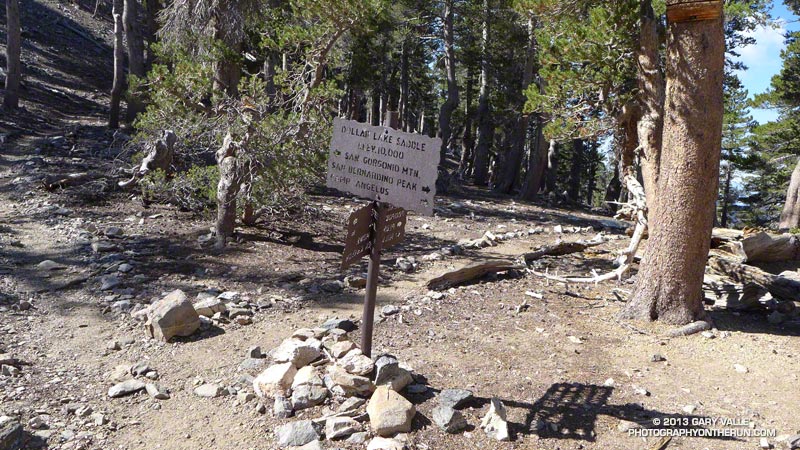
Dollar Lake Saddle was a big trail junction. The trail to the Gorgonio summit was to the left, a trail that went down to join the Vivian Falls trail was straight ahead and down and a trail westward to San Bernardino Peak went up and to the right. The elevation is 10,000 feet and I was beginning to feel the effects of not getting enough sleep and the thin air of high elevation. I remembered from my general aviation days, that the air density at 18,000 feet is half that of sea level, on a standard day. For example, an airplane engine that produced 400 horsepower at sea level, would produce only 200 at 18,000 ft., without a super charger, because of the thin air. The performance of a human would have a similar drop in efficiency, maybe worse. I felt as if I needed a nap. Lloyd went along with all this. I tried to sleep, but it wasn't happening, so I got up and we pressed on. There was a geezer who we kept seeing on the trail. We would pass him, then he would pass us. Finally, he just kind of left us in the dust, because I was really dragging ass. I think that guy was going down a shorter trail from the top and having someone pick him up, so he wasn't worried about getting back to the same trailhead. We weren't either, but we should have been. I was thinking that this would be my last time ever to attempt this hike and I wanted to get to the summit. I'm guessing Lloyd was and, in my fuzz brained way, I was crunching the time numbers and began to realize we were running out of time to do all that. I simply couldn't go any faster. When you do hikes like this, you have to make an educated guess as to how much time it takes to get back to your trailhead and establish a bingo time for climbing. When you get to that time, you turn back. We were blowing right through our bingo time, but not discussing it. Dumb. Lloyd was feeling good and would press ahead, then wait for me. I began having weird micro-hallucinations. I would think I was seeing a rock or tree shake slightly, as if there was an earthquake. A couple times, I thought I saw Llyod's face hiding behind a bush. These were all the creations of a mind that was fatigued and starving for oxygen. We reached Dry Lake View, which was the top of a cliff, from which you could look down to Dry Lake on the other trail to the summit. I'll bet you have already grasped the meaning of the name. This lake would fill with water during the Spring thaw and then dry up later in the summer. From there, the trail traversed the ridge to the west. As we rounded the western shoulder of the ridge, there were ancient trees that bore the brunt of the winter winds at this high elevation. We were nearing 11,000 feet. We switched back to a southeasterly direction and would soon come to the short trail that led to the summit. There was a steep drop to the left, that was covered with snow. This made the air along that part of the trail very cold. If I remember correctly there was at least one false summit, where you see a crest ahead, think you are at the top, but when you get there, you can see that you have more to climb. Shortly, we got there and looked around. We could see Palm Springs and Mount San Jacinto next to it.
I don't remember if it was clear enough at that time to see LA, probably not. There were several stone redoubts, which allowed setting up a campsite with protection from the wind. We were discussing our return hike.
Instead of going back the same way, Lloyd allowed me to talk him into going down the alternate route, which circled around to the east side of the mountain. It was a really cool trail, but this was a dumb decision. It was a little longer and we would encounter some situations that would delay us as we descended. I was able to make better time, but these delays were critical. The first problem occurred just as we were passing south of the summit, as we looped around. Inexplicably, there was a snow field there on a shear face, with large boulders at the bottom. We could see that hikers had crossed before us, by the footprints in the snow. Because of the thaw/freeze cycle, the snow was more like little ice marbles. We started across very gingerly, being careful to test each step before putting full weight on that foot, using our trekking poles for extra security and being careful to lean into the mountain. We could see where a fast slide would end and it would have been disastrous. Long story short, we made it across, but it took us about 20 minutes to cross a section that we would have walked in 20 seconds, without the snowfield.
We rounded the corner to the east side of Gorgonio and began a steep descent. At 10,500 feet, we passed through a debris field of aluminum, that was above and below the trail. We were able to determine that this was the wreckage of a DC-3. Click the hyperlink to see some of the story and some photos. A C-47 is the military version of the DC-3. We were descending, therefore gravity was now our friend, but it is necessary to be careful when descending. If you go too fast and fall, you have a greater angle of falling forward, than you do when ascending. If you lean back too much, your feet can slide out from under you on certain types of surfaces. The small rocks can be like little marbles. The thicker air was helping, but my fatigue was still slowing me down from my best forward speed. As we approached Dry Lake, the terrain was flat for a while and we could hustle. When we exited the lake area, we entered into a canyon with steep rocky walls on both sides. This was where the runoff from the lake would have escaped. Lloyd was still capable of moving much faster, so he stopped to do some map checking and knew he could catch me easily. I had been thinking about throwing my cheap backpack away, because by this time, it was becoming very uncomfortable. I came around a bend, saw a big flat rock laying at about a 35 degree angle and some very quick movement of an animal that moved like a cat. It was a cat, a cougar cat. It must have been more startled than I and more able to do something about it than I. It jumped down off the rock, crossed the trail from right to left and disappeared silently into the woods. The hair on the back of my neck was standing up. I didn't have much reserve energy to do more. The only weapon I had was my trusty Swiss Army Knife. I took it out of my pocket and opened the largest blade. I stood there for a few minutes until Lloyd arrived. I asked, "Did you see that?" "See what?", he asked. "That f**king cougar", I replied. "No", he responded. I described what I saw and where it went. I had told him about the micro-hallucinations I was having at the higher elevations, but said I didn't think I had just had another. We proceeded warily past the big rock and were on the alert for the next few miles, but that cat was probably long gone and had been more frightened than I was. Approaching the point where the trails split, we could see that water was still running high in the creek. At that point we were a little concerned about crossing and getting wet, so we searched for an easy place to cross. Upstream a little, we found a fallen tree laying across and used that to get to the other side. Lloyd walked across, but I did not trust my balance and sat on it and kind of scooted across. We were able to refill out water bottles, for sure. There was a mountain to the west of us on the next section of trail and we could see what we had refused to think about for the last several hours. It was going to get dark long before we could cover the distance back to the trailhead and our ride back to the hotel. Because of the mountain to the west, the sun was setting early for us and we began to negotiate the rocks and roots along the trail in reducing light. As we approached Poop Out Hill again, we rested and discussed spending the night there. That idea was soon rejected and we pressed on, with Lloyd taking the lead, because he said he was more familiar with the trail. I could make out the difference in color or shade between the trail and not the trail and several times watched as Lloyd was heading for the rhubarb, off the trail. I took the lead, because it was apparent my night vision was better than his. I remembered my army training that it is better to use peripheral vision in the dark because of the location of the rods and cones on the retina.
Finally, we arrived at the paved road I mentioned earlier. We still had some distance to hike on the trail, but Lloyd had a plan he had been working on since just before the sighting of the cougar. Since he could travel much faster than I, he would walk down this winding road to where it joined Jenks Lake Road. If you click the hyperlink, you will see the map. The trail to the South Fork Trailhead was shorter, but there were some hazards. It was windy and there were some steep drop-offs that would have been hard to see. Lloyd told me to walk down the road, following him and when I got to the gate on our road at Jenks Lake Road, wait there for him. He planned to walk ahead, get our rental and return to pick me up. We were two airline pilots who had decided to do this big adventure and were not prepared to see in the dark. We had not brought lights. Lloyd did have a book of matches and showed me the map. As I walked in the dark, I could barely see the road and was kind of depending on being able to feel the pavement under my feet. The map had indicated a few turns. After I thought I had made those few turns and should be at the gate, I began to wonder if I had walked off on another road without knowing. I could hear noises in the woods and was thinking my cougar pal might be stalking me. There was starlight and I could hear the far off voices of kids. That probably came from nearby scout camps. On and on I walked, for what seemed like too long. Finally, I came to the gate. No Lloyd. I saw a big sign to the side of the road. I was very tired. I was wearing a ski parka and got down on the pavement, on my side and fell asleep. I don't know how long I slept, before my shoulder began to feel cold. I had compressed the layers of the parka and this woke me. I felt better and got up. Still no Lloyd. I began to worry. Was I saved from a cougar attack, because the cat had gotten Lloyd. Nah. I probably would have heard his screaming in that distinctive, unusually high, Lloyd voice. He had told me about a night he was flying at UPS, when every time he called up on the radio, someone said, "Hi Lloyd". After about the third or fourth time, his first officer said, "Who are you?" I paced to warm my self and worried. Finally I heard the unique voice calling my name in the dark. I responded. When we joined up, he told me his story. He had walked toward the trail head on Jenks Lake Road. He had the same experience I did. He soon thought he should have been there and worried that he had made a wrong turn. He used his last match to look at the map, walked a little more and decided to return to the gate. He did not believe the road was Jenks Lake Road going to the South Fork Trailhead. I took him to the big sign and we could just barely make out the words Jenks Lake Road and South Fork Trail, with a big arrow pointing in the direction Lloyd had just returned from. I said I felt revived from my little nap and we should walk together down Jenks Lake Road. He showed my where he stopped to light his last match and soon we came to the point where he turned back. I said, "Let's keep going." I swear, we did not go 30 yards more and we could see the sign for the trailhead. Wow. We got in the rental and as we drove back to our hotel in Riverside, I told Lloyd that I was done with these high mountain hikes. He looked relieved. We had been discussing a planned hike to Mount Whitney, the highest mountain in the US outside Alaska. You may remember that I mentioned learning about that back in the Pacific Express days. I think he was apprehensive about that and did not really want to do it. We got to the hotel and I got a few hours sleep, before I had to get up to catch a jumpseat home on the 747. I was the only rider that night and had a big first class type seat. I fell asleep as soon as the wheels went in the well and slept until the landing woke me. Later, as I was describing the Death March to my son, Mike, I told him I had decided to never do these hikes again, because of all the dumb things we had done. He said, "But look at all the things you learned." Hope. Look out Mount Whitney.
I've been away from this endeavor for 18 months. It's time to get back to work. After upgrading to captain at UPS and experiencing a contract between the union which represented the pilots of UPS and the company, that finally got our income in the range of what airline pilots are supposed to earn, the biggest struggles of my career had been conquered. It was now time to begin enjoying my success. At the time that I upgraded to captain on the 757/767, my favorite activities were skiing and hiking. I tried to bid for trips that had weekend layovers in western cities, where I could go skiing in the winter and hiking/camping in the summer. There were some memorable episodes. When I got my bid award and saw who I would be flying with, I would call them and explain my plans, asking if they cared to join me. There were some with whom I had already flown and some who I did not know. It is amazing to me that so many of them could be so easily talked into these adventures. Many were repeaters and joined me for both hiking and skiing expeditions. One guy who did that was Glenn Gorton. Our first such weekend was in Portland. We decided to rent a car and drive up the Columbia River to the Columbia Gorge, then turn south to climb the northern slope of Mount Hood. As we drove toward the snow capped peak, we passed several farm markets. We stopped at one and bought some local apples. We were planning to drive to Timberline Lodge and hike from there. I first learned of the lodge when I was flying for Pacific Express. It was used for exterior shots in the movie The Shining. At first the weather was excellent, but as we climbed around the eastern side of the mountain, it started becoming cloudy. As we neared the lodge, we were in the clouds and it was raining. We parked and went into the lodge to explore a little. It was nothing like the interior scenes of the fictional Overlook Lodge, where Jack Nicholson went nuts in The Shining. The movie was based on a Steven King movie of the same name. King received his inspiration from a visit to the Stanley Hotel in Estes Park Colorado and his recovery from alcoholism. Doreen and I visited The Stanley with her sister. It was built by Freelan Oscar Stanley, inventor of the Stanley Steamer. This hotel is in the middle of town and its location is nothing like the remote Timberline Lodge. Glenn and I decided the weather was too wet for hiking, so we drove down the western slope of the mountain, toward Portland. Eventually, we dropped out of the base of the clouds and the rain stopped. We began looking for a hiking trailhead, found one and did a quick hike. It was not especially memorable, except that Glenn walked much faster than I did. Glenn and I drove to Snow Summit Ski Resort near Big Bear Lake, east of Los Angeles. Glenn had never downhill skied before, so I had a chance to practice my ski instructor skills. We went to the bunny slope first, but were not making much progress. It was too crowded with little snow bunnies and was not steep enough to get enough speed to learn how to use edges to turn. Standing next to Glenn, I pointed to the top of the mountain and said, "We are going up there". Glenn said, "WHAT?!" I said, "Don't worry, I have a plan". I explained that there was a green slope that traversed the slope and was not steep, good for learning. Glenn looked like a man going to the gallows as we got on the ski lift. He looked even worse when he looked down the mountain from the top. I taught him how to snow plow and then I taught him how to fall - up the mountain, not down if avoidable. Then, of course, I had to teach him how to get back up. These were all activities at which I had vast experience and was a polished expert. Then we discussed and demonstrated going from a snow plow to getting the skis parallel. This was a little more challenging, because Glenn had a forty year old body, had never done this before, had a job and a family and was smart enough to know he could be hurt. He had to become accustomed to the feel of the speed and gain confidence in his ability to turn. As you may recall, I learned to ski late in life and had gone through all this myself. Kids learn this sport very quickly, because all of the above is not true for them. We kept plugging away at it, both being patient with the other. I would ski down several yards, demonstrating and talking about what I was doing. Then I would stop and tell Glenn to try it. He fell a lot, at first, but began to show slow improvement. By the end of the night, he was able to find a way down the mountain and had caught the bug. Many years later, he is going skiing on his own or with his son and is often bugging me to go with them. One summer, I had a bid period with my pal, Alan Hanaoka. Al was from Honolulu and we always had fun flying together. Every one of our weekend layovers was on Ontario California. We did a big mountain hike on each one. We hiked the North Fork of the Santa Ana River Trail toward the summit of Mount San Gorgonio. We did not have time to do the entire 11 miles to the 11,500 foot summit, but did get to Dollar Lake at nearly 10,000 feet before we turned back. On another hike, I made the mistake of choosing a mountain with less elevation. The problem was that it was summer and we did not have enough water. We used all of our water getting to the summit and on the way down, we began feeling the effects of dehydration. After dragging our sorry butts back to the car, we raced down the winding mountain road, until we got to a convenience store, where we each bought a few gallons of sports drinks, etc. and laughed our asses off. I hiked from Donner Summit in Northern California with a guy named Jerry, whose last name I can't remember. We went south on the Pacific Crest Trail toward Squaw Valley Ski Resort. Jerry was another guy who hiked much faster than I did. No biggie. Everyone hiked faster than I did. One of my solo hikes was on the Vivian Falls Trail to the San Gorgonio summit. It was another late start, so I intended to camp on the mountain. When I got to High Camp at 10,000 feet, I encountered a mountain face that was covered with deep snow. It was still a little early in the hiking season. I was not prepared or trained to deal with such conditions and it was getting late, so I camped there by myself. While still short of the camp, a couple young guys passed me and said they were going to camp at High Camp. However, just before I got there, the guys passed me on the way down. One of them had begun to feel the effects of mountain sickness. Sometimes, being able to hike fast up these high mountains is not a good thing. Going a little slower allows more time to adjust to the thin air. I had a few camper meals and prepared a dinner after I set up the tent. I looked for a tree from which to hang my other food. this was bear and cougar country. After dinner a guy came down the trail out of the snow. He was wearing those clunky boots mountain climbers use with their crampons, those spiky things that allow them to climb in icy conditions. As it became dark and I was finally alone, next to the creek, I began to hear every noise in the woods. My imagination ran wild and I did not get much sleep. I was worried about whether I had selected a good tree to hang from and had I gotten it high enough and far away enough from the tree trunk. Or, did I do a good job, which frustrated the wild animals which then decided to pay me a visit? When I began to see first light, I got outside, retrieved my unmolested food bag and checked out my breakfast. Oops. I thought it was one of those ones that you just added hot water to, but it was some egg goo, that was supposed to be cooked in a skillet. I didn't want to do that, so I boiled some water, poured it in the package and ate that slop, just to have enough calories for the hike down the trail. Every one of these adventures is a learning experience. Another solo trip was to ski at Snow Summit. It was a great day, I had as much fun as you can have my yourself. As I got into my rental and turned on the radio, I learned that Dale Earnhardt had been killed at the Daytona 500.
The story related in the video linked to above is one that could and should motivate you. However, it could also be a story that tells you that you are barking up the wrong tree. I did not give my all in the effort to become a pilot until five years after my first lesson. I did not have that drive or hunger to make that leap at first. It was not until I had made several other attempts to figure out what I was going to do with my life and had been beaten down in those attempts and by a divorce that I got what I refer to as fire in the belly. Les Brown calls it hunger. It is something inside that clicks and tells you to go all out, make the total commitment. Unfortunately, some people never get that feeling, about anything. I believe it is essential to have that feeling when attempting to build a career in aviation. The same is certainly true of other challenging and worthwhile professions, but I can only speak of flying airplanes. I am not a mind reader, but when I was a flight instructor, I had students who seemed to be very surprised by the process of learning how to fly. It was as if they had thought it was going to be easier than it was, that they would just pick it up right away. As a student myself, I expected it to be more difficult than it was. My life up to that point had taught me to expect to be challenged to the limits and beyond. I had that hunger, that fire in the belly, that prepared me to come away from a lesson feeling wrung out and pushed to beyond my ability to perform. Overstress me and find my breaking point, so that I was over prepared for the realities. I wasn't masochistic, I wanted to know that I had seen the toughest scenarios possible in training. My last several instructors seemed to realize that and were happy to comply. I mentioned it before, but I remember a day when I was working on my instrument rating, spending an hour or so sitting there with a hood on my head, so that all I could see was the instrument panel. Watching those little gauges, interpreting what they were telling me and then doing what was necessary to comply with what the instructor told me to do. The instructor looked at me and said, "You like this shit, don't you?" I remember thinking, "Yes." I was hungry. I had the fire in the belly.
Flying the 757 was one of the great pleasures of my aviation career. It was a real challenge to learn how to use the Flight Management System, but the plane flew like a dream. It had a great feel and it encouraged me to fly it the way I had flown some of the better light airplanes I had flown.
It was a flexible airplane. It mixed in well with the big planes at the big airports and it mixed in well with the small planes at the small airports. The way we flew it at UPS, it did plenty of both. The 75 was capable of doing short flights to short runways and it was capable of flying coast to coast.
Early in my time as a new 757 captain, I flew with a young woman who had mastered the automation of the airplane. I learned more by watching her fly a complex arrival at KMDT, Middletown Airport at Harrisburg, PA. The controller was giving us lots of heading, altitude and speed changes as we were being vectored for an approach and I just sat there, talked on the radio and marveled at how smoothly and calmly she dialed up all that magic. It was the first time I had hope that I would be able to be that smooth and eventually I was.
The 757 was used exclusively in the UPS domestic system back then. I was able to fly to some of the 50 states I had not flown to yet. Connecticut, New Hampshire, Montana and Mississippi were added to my resume.
The blog is about the struggle. It is now at the point where the goal has been achieved. It began with a night in January of 1966, riding as a passenger on a TWA Constellation from Pittsburgh to Louisville KY. I was 20 years old and had been drafted into the Army. Basic Training was completed and I was on my way to begin my Advanced Individual Training at Ft. Knox. It is what I consider the first night of my adult life. I remember looking out the window of the plane, at the snow that was visible in the landing lights and wondering what it must be like to fly in these conditions. This was in the early stages of the Viet Nam War and I realized that my future was uncertain in the extreme. With all this rattling around in my head, I decided to start taking charge of my life and to stop just sitting back and going with the flow. As a captain of Boeing airplanes working for UPS, with a contract that had finally gotten me onto the same playing field with industry standard airline pilot pay, I had achieved the goals I had established for my life on that night. The goals were not specifically to be an airline pilot in '66, but they were to become someone, something I could be proud of. The specifics worked themselves out over the decades since. It was like dying and going to heaven and in the words of my old First Sergeant in the Army, I was in "hog heaven". As I said recently, if I had met the person I became as a UPS 757 captain back in 1966, I would have been in awe. Of course, when you finally achieve that status, you are not awed, because you have been around many other people who have reached that level. No biggy. With all that in mind, it is hard to know where to go with the blog. The mountain has been climbed. Hey, that gives me an idea. I can talk about some of the activities I became involved in during my leisure time, on layovers.
The Boeing 757 was the most capable and versatile airplane I had ever flown. The only problem was that it was so complicated, it took me a while to begin to feel comfortable flying it. I flew it as a first officer for about one year and because I was relatively senior in my seat, I flew the better lines of flying time, with the more senior and experienced captains on the airplane. Many of them were instructors on the 757 and in effect, I was able to continue my training on the plane for that year. When it takes me a while to learn something, I tend to keep my nose to the grindstone and learn that something to a level beyond what most people learn it. As I flew the 757/767 for the next several years, I could see that I understood how to operate its complex flight management system better than most of the people I flew with.
The 757 and 767 were designed and built to be very similar, similar enough that they required only one common type rating, with training on the few differences. They were very different in size, but the sight picture from the cockpit was very similar and my strategies for landing them were very similar. To be honest with you, they were very similar in landing strategies to the 747s I flew also.
The airplanes flew their approaches, with the flaps and leading edge devices extended, with the nose up and in a landing attitude. There was no flare required to get the nose wheel up, so that you could land on the main gear and not "wheel barrow" the plane on the nose wheel. It just took a little back pressure to reduce the rate of descent slightly, then release that a little to get a touchdown that left some guessing if you had indeed made contact with the runway.
I must admit, I liked the 767 better, because of a more complex and effective aileron and spoiler system for roll control and because it was heavier and more stable at slow speeds. I made a landing in Ontario California during Santa Ana winds in a 767, that I probably would have aborted in a 757. It just flew more stably with more roll control. My first officer said, "You made that look like child's play". It was the airplane, but I like remembering that.
Anyway, the 757/767 systems provide much more information than any plane I had ever flown. There were computers that told you things you had to calculate/guesstimate for yourself in the old days. The plane had triple redundancy on many things, such as autopilots, so that the plane could fly itself to a landing, without you ever seeing the runway. The plane did all that and we just had to monitor and make sure nothing was going wrong. The autopilots in older planes were so bad, we alway believed we could do a better job than they did, but on these newer planes, the autopilots were excellent. They could fly an approach flawlessly, land, the roll to a stop on the centerline of the runway, with zero visibility. It was all done electronically. True magic.
In the US, these planes were limited by electronically reported visibility. A device called Runway Visual Range (RVR) measured visibility at several points on the runway in hundreds of feet and we needed to have at least 600 RVR reported to commence an approach at runways that were designated Category IIIB. I don't want to bore you and I don't remember all the requirements needed to make a runway, airplane and crew Cat IIIB qualified, but it is extensive and pilots have to train initially in a simulator to be qualified and recurrently every year to maintain that qualification. The plane and its fantastic systems are flying the approach, but the pilots are monitoring and standing by to take over in the event something goes wrong. It is very intense. You are sitting there, depending on all of this magic stuff to be working correctly. Of course, we have been working our way up to this level of trust in the systems for the entirety of our careers. I recently listened to an interview of Jeff Gordon, the NASCAR race car driver about his progression. He said that you work your way up to the 200 mph speeds going into a tight corner at Daytona or Indianapolis. We were doing these things, because we had been conditioned to do so over many years.
After one year as a first officer, I went back to training to upgrade to captain on the 757. I requested Helmut as my instructor. At some point in my simulator instruction, Helmut said, "Denny, you seem like a different guy". I said, "I am a different guy" and I felt really, really good. I had beaten this challenge and forced my geezer, old school mentality to learn this plane and this modern method of flying airplanes and I was finally going to be an airline pilot, making airline pilot money. I can't tell you how important that was to me. This was the achievement of a goal I had established for myself in 1968.
I am a guy who carries those moments of defeat forward. I use them to drive myself to achieve. I don't fuck around. When I am like that, don't get in my way.