If you are coming into this blog at this late point, it might be helpful to explain where the story begins. In the right hand margin over there, you will see under Flexible Flyer, the expression, View my complete profile. Click on that and then click on Pivotal Night. That is the beginning point of the story of my aviation career. Or you can try clicking the link below.
http://denbo4294.blogspot.com
Wednesday, March 9, 2016

Hanging In There.

Flying had become a form of therapy for me. Without boring you with all the things that had been troubling me since I began this career path, I can tell you that getting in a plane and flying away somewhere made me feel better. During the 16 months I had spent in Atlanta and the 3 years I would spend back in Pittsburgh, I had to find ways to get my therapy.
I had a couple friends who owned planes I could use, just for putting gas in them and I could rent a Cherokee 6 for a good rate from another friend. All I had to do was call and schedule with them.
Another opportunity was to fly some of the USAir flight simulators, mostly the BAC 1-11, but the DC-9 and F-27, also. Occasionally, there would be a student in our class who did not have a partner to fly with during simulator training and Jim Quinzi would let me have the time to join them in the Sim. I got to know all the BAC instructors and check airmen and they seemed to appreciate my offering to help. They would let me fly some approaches at the end of the training sessions. I was also learning all the procedures and simulator training and check ride profiles.
I think Quinzi appreciated my getting an insight into that side of the process and that I was a pilot. I was able to bring that perspective to the classroom. Frankly, I thought there were some things that were being taught that did not really pertain to pilots. For mechanics, it was good to know. For pilots, it was boring.
As I began learning more and more of the systems, I found that I had to learn language to explain things, that made sense to me. Sometimes, Doc or Jim would say something and I felt that if I said it that way, I could not defend what I had said, if it was challenged by a student. This forced me into the books, to try to get a better understanding and to learn the language that made sense to me. I would go to Jim and Doc with my new language, to ask them if it was correct or not. They kind of had their own systems that they taught all the time and I was learning all of them.
With Jim, it was easy. He would say yes, or he would tell me what was not right and help correct it. With Doc, I felt like I was talking to a tape recorder. When I tried my new language, he would repeat what he would say in class, almost verbatim. When I tried to get him to tell me if my way of saying it was right or wrong, it was as if he would press Stop, Rewind, Play. Same words, almost verbatim. He was not being a wise guy, he just had his way of explaining it and that was it. I frequently went to Quinzi to ask him what he thought about my way of explaining the systems that Doc usually taught.
It was not a big deal, just a little challenging. They were both terrific guys and I really liked both of them. I often knew that my way of explaining it was better for pilots and my experience at the flight engineer school told me I was getting it right. The systems from one of these big planes to the other are very similar.
When I first came to USAir, there was a widely known, but unspoken understanding, that USAir did not hire pilots who were older than age 30. I was 35 when I started. It was a subject that came up only once at the ground school and I can't remember the exact words, but I was told to forget about it. I also sensed that management in the flight department did not want the ground school to become a stepping stone to a pilot job, because of the turn over. If I was going to get out of there to a good flying job, it was going to have to be with another company. At that point, my USAir opportunity did not exist.
I started trying to make connections with some of the customers who sent their pilots to USAir for training. The BAC was a rather small plane for an airline, about 79 passengers. It was a very nice size as a corporate airplane, about 25 to 30 passengers with a corporate interior. These were usually made up of club seating, couches and could even have a bedroom. A center wing fuel tank and auxiliary tanks in the baggage compartments gave it a very nice extended range.
Some of the companies and people who owned BACs and sent their pilots to USAir for training, were Dresser Industries (now part of Haliburton), Kenny Rogers (the singer), Amway and the Queen of Mean, Leona Helmsley.
Kenny's pilots looked just like him.

Leona's pilots looked nothing like her.
The problem with this was that these people did not want to anger USAir by hiring one of their instructors away. Furthermore, because everyone was meeting me as a ground school instructor, the way first impressions work, they saw me as a ground school instructor who flew airplanes, rather than a pilot who was working temporarily as an instructor to put food on the table.
The flame of hope of getting a job as an airline pilot was getting dim and sometimes flickering. I felt as if I had gotten myself into a maze without a way out and I was running into dead ends with every path I tried to follow. Furthermore, I was getting older every day and that was working against me with the airlines.
I was rereading my Psycho Cybernetics book during this time and trying to keep a positive attitude. I did enjoy the job and some of the class groups were fun to work with. I had jump seat privileges and was able to travel with very little expense. I was contemplating what it would be like to spend the rest of my life at this job and it was not intolerable, but that did not stop me from scheming.
I was meeting many of the young pilots who were getting hired by USAir and was responsible for teaching them the systems of the airplane they were going to fly. Frankly, I did not see that they had anything more going for them upstairs, because of their college degrees, than I did. I probably had a college degree's worth of smarts from my time in the army, the various jobs I tried, but did not succeed at and the 6 years I spent at Butler and Atlanta.
I flew such a variety of people at Butler and frequently had lots of time to talk to them while flying from A to B. They were captive audiences. I was good at picking their brains and learning about the attitudes of successful people. I flew a judge, a US congressman, a state senator (minority leader), several car dealers, a guy who sold drag lines for coal mining, and on and on. Rocky Bleier, the Steeler running back was one of the most positive attitude dudes you could ever meet. He had his foot partially blown off and came back to play for a team that won 4 Super Bowls, running for 1000 yards one season. He was a great motivational speaker as a result of the effort he made to rebuild his football career. They don't teach any of that in college, but they should.

Sunday, March 6, 2016
Holtzer II
I learned that the USAir ground school was looking for several additional instructors to help introduce the Boeing 737 to the fleet. I had remained in contact with my friend, Walt Holliday, at Flight International, in Atlanta. This seemed like a match made in heaven.
I called Walt and asked him how things were going. He said he had started working at a store that sold tile, because things had slowed at the school, even more than when I left. Furthermore, a slow down of airline pilot hiring was the cause, so that escape was not available to any of us.
I told Walt about the openings at the ground school and asked if he was interested. He was and got back to me with a question concerning our friend, Bill Shinnock, who was still there and another guy named Frank Ruba. Frank was a medically retired TWA pilot and Walt wanted to know if these guys could apply also. I checked with Ron Barnett, the manager of the ground school, and he seemed very pleased to have an opportunity to talk to three such highly qualified people. They interviewed and were all hired.
This was great for me, because I had some of my old friends to hang out with and best of all, Walt was a skier. He would join me frequently to drive to some of the resorts east of Pittsburgh.
One day we decided to drive a little farther east to Blue Knob Ski Resort.

It was a bitter cold day. As we were driving there, I remember seeing a crust of ice on top of several feet of snow. I had read stories about how harmful this condition was to the deer population of the Keystone State. They were post holing through the upper crust and breaking their legs. This foretold of nasty conditions for skiers, also.
I think Blue Knob is the highest elevation of a ski resort in PA. Another unusual aspect is that the lodge is at the top of the mountain. You ski down then ride the chair back up to the top. The weather was so bad, we were practically the only skiers there that day. We had the mountain to ourselves, but who wanted it?

It was bitter cold and windy. The ride on the lift chair was brutal. The seats were covered with ice. We talked about leaving, but wanted to justify the long drive and the cost of the lift tickets. We gutted it out, by going into the lodge after every second or third run down the mountain and agonizing ride back up. Coffee, hot chocolate, schnapps, were all on the menu. There was black ice at every turn of the trails. Lots of sliding, no carving. While suffering on the lift, we entertained ourselves by planning to drag our friend and fellow employee, Joe Coates, out to a ski resort.
I always call Joe Couzzo, because that was his family name before someone Americanized it to Coates. Joe was not much of an athlete and had never skied before. We had then and still have a relationship in which we are constantly taking shots at each other. Walt and I planned to convince him that skiing was easy and fun and that we could teach him how to get down the mountain in one day. As we drew up our plans, we were giggling and forgetting about how we were freezing our butts off. I think I know why they call that place Blue Knob.
When we returned to work, we moved from the planning stage to the implementation stage and started working on Couzzo. Finally, we convinced him to join us at Hidden Valley. We thought that this place was docile enough to avoid killing him. We went through the ski rental phase and this was already providing us with all the entertainment we had anticipated.
Getting him on the lift was hilarious and his reaction when he first looked down the slope was priceless. We were being rewarded for enduring the nastiness at Blue Knob. I tried to explain the dynamics of turning, but I don't think he got it. I went down the slope about 25 yards and told him to ski down to me. He started down, but forgot the part about turning and headed for the tree line at the side of the slope. The scream was the most fun we had all day. Fortunately for Joe, the terrain began to rise a little just before the trees and he slowed enough that he was not seriously injured when he ran into one.
Joe's skis had released from the bindings and he did not want to put them back on, when I arrived to teach him how to get up from a fall with slippery boards attached to his feet. He carried his skis down the mountain and learned how painful walking in ski boots can be. He turned in his rented equipment and headed for the bar. That is where we found him and it is a good thing he didn't have to drive home that day.
Now, to explain the title of this post and a previous one.
I mentioned a guy named Jim Oberholtzer in the last post. He did go skiing with me that one time, but he was not a guy who was well liked by most of the other instructors. He was smart, but he was obnoxious. That is why I did not feel bad when I abandoned him while skiing with the young woman we met at Peak 'n' Peek.
You may have noticed I have this thing about giving nicknames to people. I think I inherited that from my grandfather, who gave such names to most of his 8 children and many of his 26 grandchildren.
Walt inherited a desk which had previously been Oberholtzers. Walt's nickname, even before I met him, was Hollie. It may have been his call sign in the Air Force also. Anyway, I started calling him Holliholtzer and this was shortened to Holtzer. So here we are in 2016, more than 34 years later, calling each other Holtzer every time we see each other or talk on the phone.
Holtzer is one of the people who knows just about everything there is to know about my long time struggle to land the airline pilot job of my dreams.

I called Walt and asked him how things were going. He said he had started working at a store that sold tile, because things had slowed at the school, even more than when I left. Furthermore, a slow down of airline pilot hiring was the cause, so that escape was not available to any of us.
I told Walt about the openings at the ground school and asked if he was interested. He was and got back to me with a question concerning our friend, Bill Shinnock, who was still there and another guy named Frank Ruba. Frank was a medically retired TWA pilot and Walt wanted to know if these guys could apply also. I checked with Ron Barnett, the manager of the ground school, and he seemed very pleased to have an opportunity to talk to three such highly qualified people. They interviewed and were all hired.
This was great for me, because I had some of my old friends to hang out with and best of all, Walt was a skier. He would join me frequently to drive to some of the resorts east of Pittsburgh.
One day we decided to drive a little farther east to Blue Knob Ski Resort.
It was a bitter cold day. As we were driving there, I remember seeing a crust of ice on top of several feet of snow. I had read stories about how harmful this condition was to the deer population of the Keystone State. They were post holing through the upper crust and breaking their legs. This foretold of nasty conditions for skiers, also.
I think Blue Knob is the highest elevation of a ski resort in PA. Another unusual aspect is that the lodge is at the top of the mountain. You ski down then ride the chair back up to the top. The weather was so bad, we were practically the only skiers there that day. We had the mountain to ourselves, but who wanted it?
I still remember this spot. It had the biggest area of black ice that day.
I always call Joe Couzzo, because that was his family name before someone Americanized it to Coates. Joe was not much of an athlete and had never skied before. We had then and still have a relationship in which we are constantly taking shots at each other. Walt and I planned to convince him that skiing was easy and fun and that we could teach him how to get down the mountain in one day. As we drew up our plans, we were giggling and forgetting about how we were freezing our butts off. I think I know why they call that place Blue Knob.
When we returned to work, we moved from the planning stage to the implementation stage and started working on Couzzo. Finally, we convinced him to join us at Hidden Valley. We thought that this place was docile enough to avoid killing him. We went through the ski rental phase and this was already providing us with all the entertainment we had anticipated.
Getting him on the lift was hilarious and his reaction when he first looked down the slope was priceless. We were being rewarded for enduring the nastiness at Blue Knob. I tried to explain the dynamics of turning, but I don't think he got it. I went down the slope about 25 yards and told him to ski down to me. He started down, but forgot the part about turning and headed for the tree line at the side of the slope. The scream was the most fun we had all day. Fortunately for Joe, the terrain began to rise a little just before the trees and he slowed enough that he was not seriously injured when he ran into one.
Joe's skis had released from the bindings and he did not want to put them back on, when I arrived to teach him how to get up from a fall with slippery boards attached to his feet. He carried his skis down the mountain and learned how painful walking in ski boots can be. He turned in his rented equipment and headed for the bar. That is where we found him and it is a good thing he didn't have to drive home that day.
Now, to explain the title of this post and a previous one.
I mentioned a guy named Jim Oberholtzer in the last post. He did go skiing with me that one time, but he was not a guy who was well liked by most of the other instructors. He was smart, but he was obnoxious. That is why I did not feel bad when I abandoned him while skiing with the young woman we met at Peak 'n' Peek.
You may have noticed I have this thing about giving nicknames to people. I think I inherited that from my grandfather, who gave such names to most of his 8 children and many of his 26 grandchildren.
Walt inherited a desk which had previously been Oberholtzers. Walt's nickname, even before I met him, was Hollie. It may have been his call sign in the Air Force also. Anyway, I started calling him Holliholtzer and this was shortened to Holtzer. So here we are in 2016, more than 34 years later, calling each other Holtzer every time we see each other or talk on the phone.
Holtzer is one of the people who knows just about everything there is to know about my long time struggle to land the airline pilot job of my dreams.

Friday, March 4, 2016
Widow Maker
I started trying to go skiing at the resorts in Western Pennsylvania the first winter I was back. It was not easy to find someone to go with, so I went alone frequently. Skiing conditions in the entire Northeast are not always good. It will get cold and snow a lot, then it will get warm and the snow will melt. When it gets cold again, the surfaces become icy. There is a phenomenon called "black ice". It is dark and solid. Ski edges merely slide across it. It is very scary for a novice skier.
This was early 1980, I was 34 years old. That is a little late in life to start learning how to ski, but not too late. I started buying ski related magazines and reading instructional articles. When I was riding up the hill on the lift, I watched other skiers and tried to understand what they were doing, then imitating it on the way down. Progress was slow but sure.
I had not enjoyed my previous trip to Seven Springs, the biggest resort near Pittsburgh, so I started going to smaller places like Hidden Valley and Laurel Mountain, also in the mountains just east of the Burgh. Laurel Mountain was closed, but I just learned it has reopened.
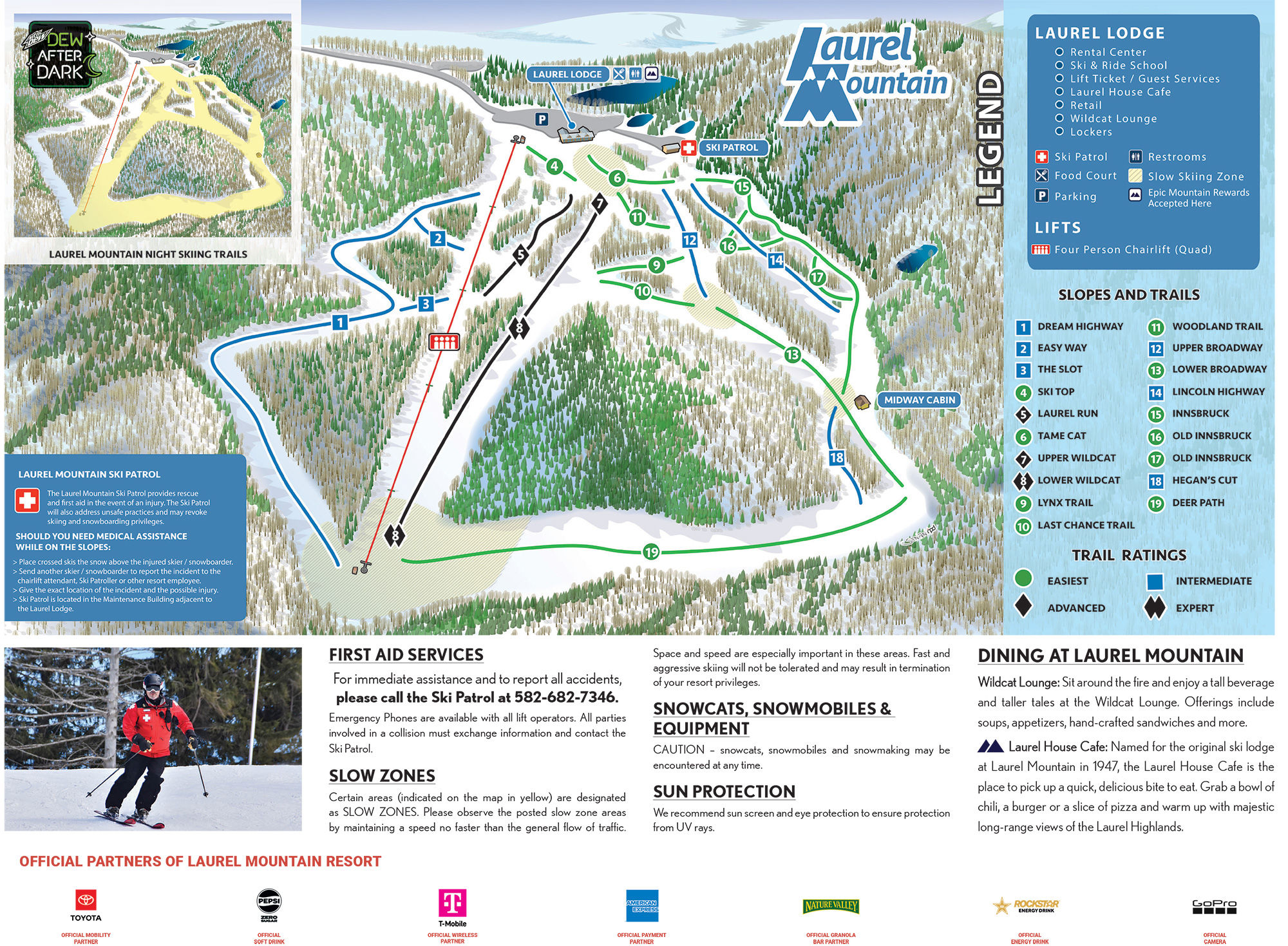
Here is a recent map of Hidden Valley.
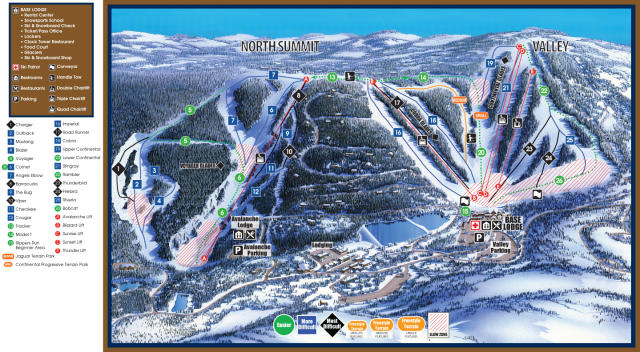
I don't think that section to the left existed back then. This place was not as crowded as 7 Springs and I felt more relaxed falling and learning.
Soon I was able to make my way down the mountain. You can see that the trails have colored symbols on them. Green trails are the easiest at the resort. Blue are a little more difficult. Black are most difficult. Double black diamond trails are for expert skiers only. You don't seem many of those at these little places. These classifications apply at the particular resort. A black at Hidden Valley could be a blue or even a green at Arapaho Basin in Colorado. I was still trying to master the greens in PA.
That first season, I don't remember how many times I skied, but I was making progress. My plan was working. I was starting to enjoy my time on the slopes and I was looking forward to getting an early start on the next season. I also started skiing at night, mostly at Laurel Mountain. It would get cold and we would go into the bar to have a schnapps to warm up. I found that I was a little braver after a couple such visits. I got a little better, because I tried doing a little more that I had been afraid to do.

Occasionally, I still found myself standing at the top of a steep hill that I had planned to ski down and realizing that it might be more than I had thought it would be. They look easier when looking up or on the lift, than they do when you are standing at the precipice.
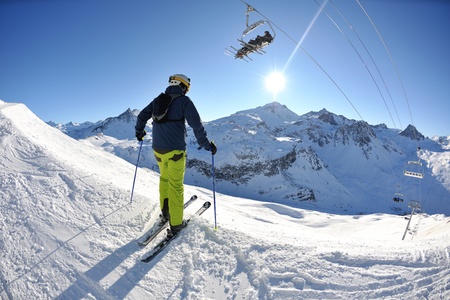
The next season, I was able to go skiing nearly 30 times. I was branching out a little, driving to resorts in Western New York, Peak n' Peek and Holiday Valley. Often I would spend the night and ski two days in a row.
Some of the guys from work were going with me. One guy, named Jim Oberholtzer, drove to Peak n' Peek with me one day. As we were boarding the chair lift, we became tangled, fell and were kind of run over by the chair, until the operator stopped the lift. A young woman back in the line started making fun of us for falling. I waited for her at the top of the lift and we had a good laugh together. She was a good skier and we skied together for the rest of the day. This was probably the best day I had to this point. I learned a lot just by following her and doing what she did.
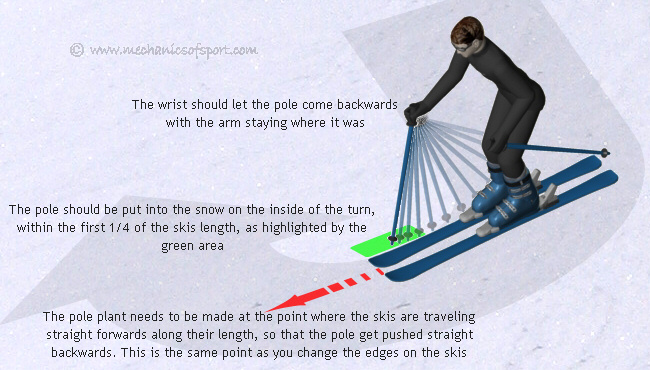
We planned to do some skiing together and went to a very small resort called Cockaigne. It is no longer open, but we met friends of hers there and one was an instructor. She asked him to give me a lesson, which would be my first ever. He told me to follow him down the hill and go where he went and do what he did. Cool. I already knew how to do that. He explained the principle of keeping the upper body facing down the fall line and doing all the twisting to make turns from the waist down. He also showed me how to use pole plants to initiate turns. I needed to work on that one.
Friday, February 26, 2016
Bend Ze Knees, 15 Dollars Please
Little brother, Kevin, rode down to Atlanta with me. It was Christmas break. I rented another UHaul trailer, loaded my junk and headed north. Ugh!
I had been enjoying the milder winters. The summers were a little too hot, but I was not crazy about the prospect of living in snow country again. It was the middle of winter, going through the mountains of West Virginia and it was not a flying job.
I spent the quiet time during the drive trying to solve that problem. What could I do to make myself look forward to winter in Pittsburgh?
The answer that kept coming back was skiing. Yeah, I only had a couple encounters with that and they were not enjoyable, but everyone else seemed to be having fun. Perhaps if I could learn how to do it.
Making a financial commitment always helps me focus. I went to Willi's Ski Shop and dropped $500+ on equipment and clothes. That was real money for me in 1980.
But before that, I started my time of employment at USAir on NewYears Eve 1979. I guess I didn't do much that first day. All I can remember is that I had a cold.
I would be working with Jim Quinzi and Doc Watson on the BAC 1-11, a small, British jet. It had been the primary plane of Mohawk Airlines, which merged with Allegheny, which became USAir. The BAC (some people pronounce it Bock, the Brits always say B.A.C.) was a stepchild airplane at USAir. Jim and Doc were mechanics and had gone to the factory school in England when Mohawk first bought the plane. There were a couple other instructors who had gone also, but they had moved on to other planes at USAir. Jim and Doc knew all the nuts and bolts of this plane and would begin my training program.
When I first started flying, Allegheny was the airline I wanted to fly for eventually. My ex-wife worked for them. My friends, Dan and J.B. worked for them. Allegheny was my home town airline and it was now called USAir, which implied they intended to grow the company's system beyond the regional system they had always operated. Pay and benefits were good and it seemed like a good place to hang out until something came along.
Somewhere in all this time, one of my students offered me a job. His company sold large, industrial pumps. He was one of the guys who got all the licenses to fly his Seneca II, but hired me when he was flying employees or customers. He had even taken me on some really cool trips to the Eastern Shore of Maryland.



The Eastern Shore is a place that seemed to have been left behind a little by the passage of time. It was quaint and beautiful. We flew down there to hunt geese on one trip and to go fishing in the Chesapeake Bay on the other. These are examples of the some of the fringe benefits of working at Graham Aviation.
Any way, this guy wanted me to work as a salesman at his company and be available to fly the airplane. There were times during the five years at Butler when I probably would have jumped at that opportunity.
The belief that I would live my dream and become an airline pilot wavered dramatically and the thought of such a corporate job would have been very attractive. However, once I made the decision to get the flight engineer rating, I felt I had to follow through and give it my best shot or regret it for the rest of my life. I explained that to my student, friend and prospective employer and he understood.
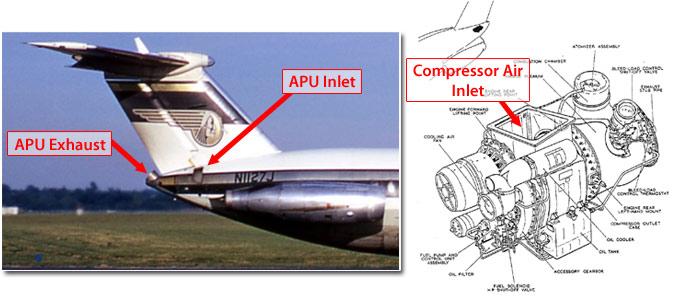
Jim Q. told me to learn one of the airplanes systems at a time. I would start with the Auxiliary Power Unit (APU). This was the small turbine engine mounted in the tail, that drove a generator to provide electrical power and used bleed air from its compressors to provide air conditioning on the ground.
Early on, Jim told the students how we taught the plane. He said that we were going to tell them what we were going to tell them. Then we were going to tell them. We would follow this up by telling them what we told them. Repetition. We reinforced this by having them talk about nearly the entire plane with each of the three of us in the classroom, to get a slightly different perspective and way of describing it from each of us. If I taught the APU yesterday, Jim or Doc would start the next day by going around the classroom asking each student what he or she had learned the previous day. We would do this until we were satisfied that all the important stuff was digested and understood. Then we would have a big overall review just before the written test.
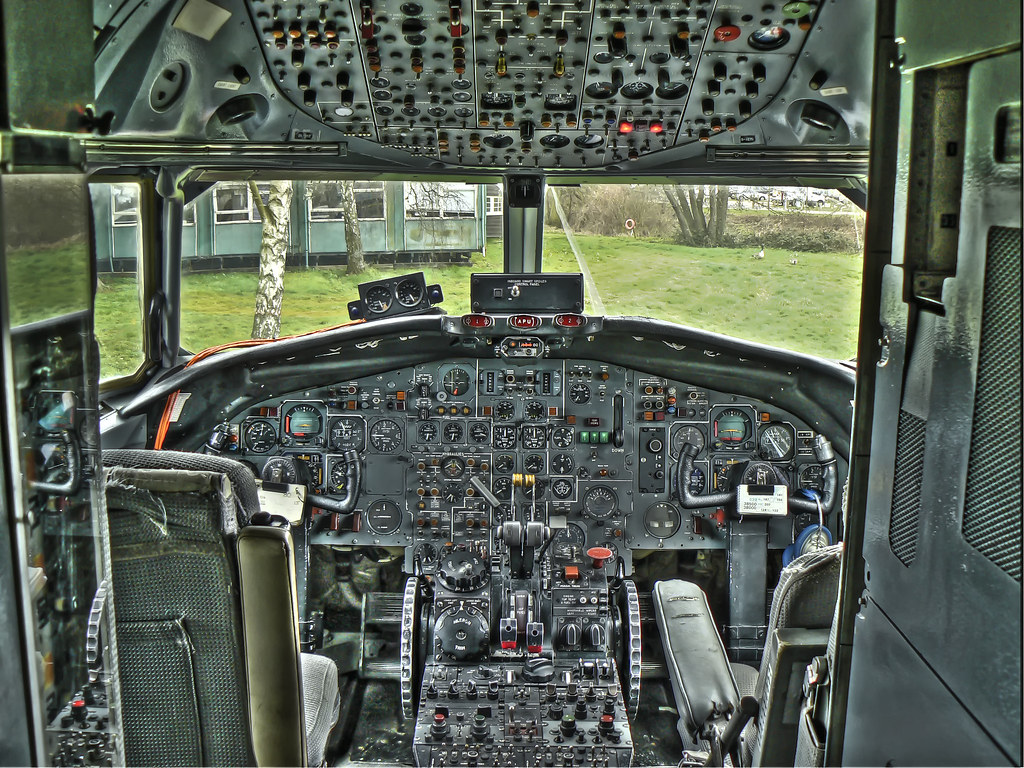
The way we told them what we were going to tell them, was teaching the "origination check list" the first day in class. This was the interior preflight check done by one of the pilots before each sequence of flights. It followed a flow pattern through all the cockpit panels, discussing every light, indicator, switch and control. We had a slide tray all ready to follow that pattern and Jim wanted me to be the primary guy to do that day.
I really enjoyed this. It sped up the learning of the entire plane for me to learn how to do that. I would tell the class that I was about to teach them everything they would ever need to know about the BAC 1-11 in one day, but that they would not be able to remember all of it. We would then spend the next couple weeks going back over all this and discussing it in detail and then reviewing. I think this gave them confidence that they would get it all and would get it well enough to retain it.
Tuesday, February 23, 2016
Too Close
If I were going to discuss all the details of my personal life, with relationships, during this career building phase, I could post this song at several stages and I would be on both sides of it. After the divorce, I decided I needed to be ready to move anywhere in the world, at any time to get an appropriate job in aviation. I tried to explain that situation in any relationship. I don't think I was always successful in maintaining clarity on that, but leaving Atlanta was not as tough as other moves.
I had been dating a young lady who worked at Flight International. In fact, she was the first person I talked to when I called to enroll in the school. We had become friends and were hanging out together as friends and it just kind of moved into the dating phase. She knew and understood the commitment to career that we all had when we came to the school or even to work there as instructors and there were no tears when I left.
Pilot hiring by the airlines runs hot and cold. It was hot when I first went to Atlanta, but was cooling down after a year. I was able to work steadily and make some money. Eventually, the number of students coming in the door dwindled. This was another deal where I got paid for how much work I did, you know, the American way. The more I worked, the more I made. I put out the word that I was looking for a job. I wanted to work as a pilot for an airline, but no one was calling.
The guys who convinced me to leave Graham Aviation and get an engineer rating, Dan Wylie and his dad, J.B. told me that USAir was looking for a ground school instructor. I sent a resume and was called for an interview. I took some time off and drove to Pittsburgh for the interview. I spent some time hanging out with my parents and brother and saw all my friends.
At the interview, I met Ron, the manager of the ground school, and Jim and Rich, who were the managers of the programs for the BAC 1-11 and DC-9, respectively. They hired me to work on the BAC. I think I might have been a little too much for Rich.

Holtzer
My good fortune at being associated with great people in my aviation career was about to continue. All the guys I flew with at Butler were great stick and rudder guys and were both smart and wise. (I was learning that intelligence and wisdom were not the same thing.)
I was working one evening and met two guys who had just transferred to our flight engineer school from the one run by Braniff International Airlines. My memory is a little fuzzy on this, but I think they were most of the way through their training when the Veterans Administration had issues with Braniff using their school and the VA's money to train engineers, then hire them. They came to us to finish up their simulator training.
They were Walt, a former Air Force RF-4 pilot and Bill a former Navy pilot. They were both great guys and we hit it off immediately. They were looking for work and we were always looking for good instructors, so I mentioned them to Rod. He quickly hired them.

The RF-4 was a reconnaissance version of the F-4. It carried cameras for taking pictures of areas before and after bombing attacks. I asked Walt what the plan was if an enemy fighter showed up and he said he would get down on the deck and go really fast. The F-4 was very fast at low altitude and the RF was much lighter than the fighter version.
His call sign was Holly and I would frequently double date with him and his wife. We drove to South Carolina to visit his parents' farm. We spent lots of time talking over beers about our aviation futures.
He will show up in a future chapter, which is when we started calling each other Holtzer. I'll explain when we get there.
Braniff was hiring like crazy at this time. These were the early days of Airline Deregulation and Braniff's strategy was to fly everywhere. They were flying B-747s all over the place and even had a Concorde. I sent them a resume and application. Someone from their HR department called and said I hadn't filled in the part about college education. When I said I didn't have one, the discussion was over. They seemed to be very happy with all my qualifications except for that. There were a few airlines that did not have that as an absolute requirement, but Braniff was not one of them. You will see the irony in this in another, later chapter.
I was working one evening and met two guys who had just transferred to our flight engineer school from the one run by Braniff International Airlines. My memory is a little fuzzy on this, but I think they were most of the way through their training when the Veterans Administration had issues with Braniff using their school and the VA's money to train engineers, then hire them. They came to us to finish up their simulator training.
They were Walt, a former Air Force RF-4 pilot and Bill a former Navy pilot. They were both great guys and we hit it off immediately. They were looking for work and we were always looking for good instructors, so I mentioned them to Rod. He quickly hired them.

The RF-4 was a reconnaissance version of the F-4. It carried cameras for taking pictures of areas before and after bombing attacks. I asked Walt what the plan was if an enemy fighter showed up and he said he would get down on the deck and go really fast. The F-4 was very fast at low altitude and the RF was much lighter than the fighter version.
His call sign was Holly and I would frequently double date with him and his wife. We drove to South Carolina to visit his parents' farm. We spent lots of time talking over beers about our aviation futures.
He will show up in a future chapter, which is when we started calling each other Holtzer. I'll explain when we get there.
Braniff was hiring like crazy at this time. These were the early days of Airline Deregulation and Braniff's strategy was to fly everywhere. They were flying B-747s all over the place and even had a Concorde. I sent them a resume and application. Someone from their HR department called and said I hadn't filled in the part about college education. When I said I didn't have one, the discussion was over. They seemed to be very happy with all my qualifications except for that. There were a few airlines that did not have that as an absolute requirement, but Braniff was not one of them. You will see the irony in this in another, later chapter.
Subscribe to:
Posts (Atom)