Featured Post

Saturday, July 16, 2016

FOs and FAs

You may remember my First Officer philosophy.  As an FO, I never wanted to put a captain out of his comfort zone.  In my experience as a captain, not all first officers share that philosophy.  When you fly with a really good first officer, it is like a Fred and Ginger dance.  Choreography, baby.


Or a tune played by Jonathan's Machete, where they do all the fancy guitar shit.


Or maybe like this.


And we have to do that, even when our heads are in the clouds.


When things aren't going well, it just seems that the 2 pilots are always bumping each other's hands or bumping heads together.  Every airline just seems to have a few copilots who have their own agenda on every flight.  They are a real pain in the ass.  You may remember when I told you about a friend at USAir who had just upgraded.  When I told him now he got to be the asshole instead of flying with the asshole, he said the first thing he learned when moving to the left seat was that all the assholes are not in the left seat.

We had a guy who had upgraded to captain, but when the company receded a little, he was bumped back to the right seat.  He was older than most of our group.  He had been a navy noncommissioned officer and was a major pain in the ass.  The flight attendants called him Grumpy.  He had a button under his lapel that said, "I'm entitled to be Grumpy".  This proves that anyone who feels entitled is a pain in the ass.

We were flying an arrival into an airport and it involved tracking a VOR radial to intercept another one, making a turn to the left.  I was tracking outbound on the left VOR receiver and had set up the right VOR in the leg we were to intercept inbound.  This gave me a Distance Measuring Equipment (DME) read out of my distance to the intersection(with some second grade math).  A few minutes later, I checked that DME and the distance didn't make sense.  The right VOR frequency had been changed.  I told Grumpy that I wanted it set on the inbound VOR and the reason.  He said that was his VOR.  I controlled my anger, but I told him the entire fucking airplane was mine and he was here to assist me.  I told him when he was flying the airplane, he could set the radios up however he wanted, but when I was flying they would be set up the way I wanted them.  

There was another guy, I will call him The Czar, who was a sharp shooter.  He was always trying to do things before I did or to seem smarter.  That is not that hard to do with me, but the problem was that he was usually wrong.  I never gave a crap about stuff like that.  To me, it was about trying to have a perfect flight, every thing went well.  I didn't care who got credit or who was the one who came up with the good idea.  I did expect the first officer to run everything through me, though.  When a copilot started thinking he or she had a great idea, I wanted to know about it, before they tried to put it into action, especially with a guy who was aways getting it wrong.

One night, after a long day, The Czar and I were flying into Columbus Ohio.  It is my leg and the wind was blowing across the runway at a speed that was near the demonstrated maximum for our plane.  Upon the first call to the tower, they gave the wind direction and speed (as they are required to do) and cleared us to land.  We were within our max. speed.  I was flying the glide slope and things were going well, when the Czar decided to ask for a wind check.  I didn't say anything at the time, but this pissed me off.  I did not want to give the controller an opportunity to give a cross wind speed that would create a dilemma.  

You may have noticed that I said we had a maximum demonstrated crosswind speed.  I always interpreted that to mean that it was not technically a limit, but if something happened on the landing and we had exceeded that, I would have to explain why I had not gone around.  We had a speed that was less than the demonstrated speed and everything was going well.  No one in the world knew more about what the wind was doing to that plane than I did at the time I was landing it and I did not want to hear a number that created a dilemma.  

If the landing was not going well, for any reason, I was going to go around.  If I got a number I did not like, I would have to go around and hope the wind numbers were better than the first attempt or go to an alternate.  Cross wind landings were something that I was especially good at.  I had learned how to do them from some of the best instructors back at Graham Aviation.  When we were arriving at our northern destinations, we did not have lots of extra fuel to mess around, waiting for the wind to get it together.

I had this discussion with the Czar after the landing and he decided to dig his heels in on this one.  I told him he could do whatever he wanted to when he made captain, but when he was flying with me, not to  ask for a wind check unless I told him to.  I would never have done any of these last two things I have told you about.  They would have been completely against my originally stated philosophy.

It's not always the captain and first officer who are bumping heads.


Most of the time, it was not like any of that.  I flew with many terrific FOs.  I remember one of them, John, as we were flying into Birmingham Alabama one afternoon.  With our older navigation equipment, you have to learn to have an intuition about where you are relative to the airport, to avoid being too high.  I became aware that we were high on this particular approach and John did not seem to be aware.  I thought about telling him, but waited to see if he would get it himself.  I was watching him out of the corner of my eye and knew the instant he realized his situation.  He suddenly sat up straight and started doing all the things he had to do to catch up to the situation.  He raised the nose to slow down, pulled the speed brakes, started extending gear and flaps when we slowed below their maximum speeds.  It was a thing of beauty.  We probably had a little extra time before it would have become a big problem for him and I really enjoyed watching him in action when he broke the code.

There were many others, but one I am remembering now was Dan.  He was a calm and cool as he could be and flew a very good airplane.  He also liked to join me for a beer, when we had enough time and we had some great discussions, solving the worlds problems  Dan was a real pleasure to fly with and we are pals to this day.

I told you about our flight attendants before.  They were terrific.  They were mostly relatively inexperienced young ladies, who took the opportunity to fly for the new home town airline.  Some of them were older women whose families were grown and were looking for a fun way to make a few bucks.  They were all starry eyed when they started and often the rigors of the job beat them down.  It was not quite as glamorous as they had anticipated and some of them had to move on.  The ones who remained were most often very good flight attendants.  They were tough and resilient.  They took some good punches and did it with a smile.  In fairness, I should point out that we had a few male flight attendants and same was true of them.

With Florida Express, we did not use jetways in Oralando.  The passengers exited the terminal through a door and walked down steps, across the ramp and up the forward air stairs of the jet.  Orlando was usually very hot, especially in the summer.  The air-conditioning on the BAC 1-11s was not very good.  There was not enough airflow.  I knew this back in the day, when I worked for USAir.  Often the Auxiliary Power Unit (APU), a small jet engine in the tail of the plane for providing electrical power and airflow for the AC, was not operating.  This combination was deadly for reals.

When the planes arrived in Orlando from the south Florida cities, the cabin was warm or even hot.  The flight was not long enough or high enough to cool things down.  The passengers we had picked up down there and were staying on the same plane had to sit in all that heat.  The number of bodies on the airplane and the ambient temperature usually had more impact on cabin temperature than the AC.

One hot summer evening, we had an older woman passenger sitting on a plane who had a heart condition.  She began to become ill and was taken out to the ramp and was lying there on the concrete as one of our female flight attendants gave her CPR.  This was a reminder that the flight attendants are there for more than serving Cokes and peanuts.  The woman died, literally as the FA was mouth to mouth with her.  Her manager made her continue on to the layover in the northern city that night.


The young man playing the green bass guitar in the above video took his own life a couple months ago.  

This is how I'd rather the world be.


Thursday, July 14, 2016

Dilemma

Part of the reason for the long layoff since the last segment of the saga, is that we are leading up to what is probably the worst part and I have to get my head right to discuss it.  Also, I want to make sure I tie up all the loose ends of the Florida Express experience.

Just to review, my adult life began the night I was traveling to Ft. Knox and not knowing what was in my near or distant future.  My world had been shaken up when I was drafted and I decided to make some big life changes as I rode on a TWA Constellation to Louisville.  After my separation from the Army, I began taking flying lessons with the sole and express purpose of becoming an airline pilot.  There were several tough issues to deal with, some of them self inflicted.  I finally got all the pilot licenses, ratings and flying time necessary to be qualified for an airline job, but could only get hired by a tiny airline in California.  However, it did get me the jet experience I needed and I had checked out as a captain, before the company went bankrupt and disappeared.  That led to my calling in on favors from some of the friends I had met along the way and getting hired at Florida Express, another tiny airline.

I have already discussed some of the reasons Florida Express was struggling.  Most of the new entry airlines, started after airline deregulation, were having similar problems.  They were all targets of the "legacy" airlines that existed before deregulation.  The larger companies could offer low fares against the new companies and subsidize with other markets.  In many cases, they offered superior service to the low cost airlines.  However, as more and more low fare companies popped up, it was forcing everyone to offer them and many of the legacies began to have trouble also.  The problem was that the system went from complete regulation of routes and fares to no regulation, literally overnight, and it became like swimming in a shark tank.  They were all trying to kill off the others.  No one could make money.

We were all watching this and wondering how it was going to effect us in the long run.  The analogy that kept running through my head was that I was on a runaway train, going down a mountain and about to go into a dark tunnel.  It looked dangerous in there and I didn't know if I would be hurt more by jumping off or by trying to ride it out through the tunnel.

If I didn't explain it before, changing jobs as an airline pilot is almost always painful.  Seniority is paramount for airline pilots.  Your income and quality of life are very much impacted by being junior on the seniority list.  You bid for schedule and vacation based on your seniority.  When I started at Florida Express, I was at the bottom of the list, number 29 of 29 pilots.  As the airline grew, more pilots were hired in below me and some of those senior to me left for other jobs.  For example, my old Annapolis grad, F-14 pilot pal, Tom went to American.  It was widely believed that working for the bigger, legacy companies was a better, more secure position.

Because I did not have a college degree, there were fewer opportunities for me.  One of them was Piedmont and I gave that some thought, then they merged with USAir.  I gave that some thought also, but anticipated possible issues applying there, since I had already interviewed and been rejected.

But, the real hang up was uncertainty and the knowledge that I was now about number 13 on the Florida Express list and we had a nice life in Orlando.  We were comfortable and making a change would mean going to the bottom of some other seniority list and suffering through a probationary year of low pay.

So, I stayed.  It was not that tough.  We had grown to about 150 pilots at one point.  Our system of cities had expanded and it was fun to fly to the newer ones.  Grand Rapids, Milwaukee, West Palm Beach, New Orleans and Knoxville were examples.  We even flew to Nassau in the Bahamas for a while.  That was fun.  We flew a couple who thought they could get a quickie marriage down there and they were on our return flight, mission not accomplished.  I joked around and said I could marry them as a captain of a ship over international waters.  I had a nice little ceremony over the P.A. and ended it by saying, "And by the powers vested in me by John Wayne and Chuck Yeager, I now pronounce you man and wife."  Touching.  I don't know if they took that seriously or not.


Friday, July 8, 2016

Dirty Dozen

I apologize to my faithful followers, all 12 of you.  I hope I haven't lost any of you forever.  I took a break. Writing this blog is kind of like exercising, even though I love it, once I have not done it for a while, it is a challenge to get back in the routine.

Thursday, June 16, 2016

LUV

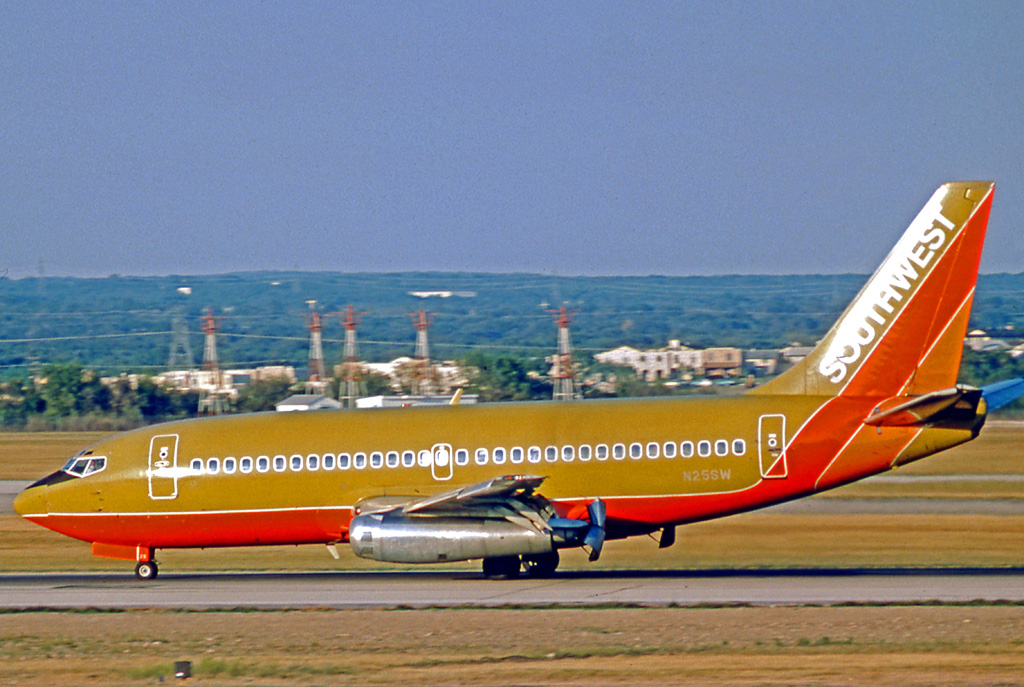
Southwest was the model for all the new entry airlines that followed as a result of the Deregulation Act of 1968.  It had been a marked success and all the others hoped to follow in its footsteps.  They created what they thought were business plans that emulated that of Southwest.  We did much of that at Florida Express.


Some of the examples were the way pilots did things that they don't do at the older, established companies.  Helping straighten out the cabin with the flight attendants after deplaning, to facilitate a quick turn and helping with the loading and unloading of passenger baggage would be a couple examples.  Working in non flying capacities, such as teaching ground school and creating schedules were a couple more.  The idea was that we had attached our wagons to this star and would be loyal in the lean times in hopes that it would become a success the way Southwest had and we would all reap the rewards.  

Federal Express was another such example.  They started flying Falcon 20s.  These were planes that had been used as corporate jets.   Nice planes, but small by airliner standards.  The business plan was to fly small, but important packages around the country at night, and to guarantee next day delivery.  They were important enough to justify a high price and hopefully help FedEx succeed.
  
It worked ultimately, but at first there were rough times.  There were stories going around about pilots needing to buy fuel and the company credit card not being accepted.  The pilots paid for the fuel on personal credit cards and were reimbursed later.  Eventually, they began to add Boeing 727s to the fleet.


The thing that Southwest and FedEx had in common, was a love affair between the company and the employees, especially the pilots.  An unpleasant fact for typical businessmen is that if you are going to run an airline, you need pilots and it helps if you have a fantastic relationship with them.  As we shall see later, not all businessmen are capable of grasping that premise.

We were close to having that great relationship at Florida Express.  The pilots were free to run the operations side without much interference.  There were certainly some pilots who did not buy into the love affair, but most did.  In the early stages, we thought the management wanted to create something like Southwest and Federal Express had created.  We thought we had a chance of making it and reaching the levels of pay that existed at the traditional airlines.

I can remember a few flight attendants complaining about heavy passenger loads, when we were in our busy times.  Occasionally, I was inspired to explain that the passengers were the reason we needed flight attendants and if they ever stopped showing up, we didn't need flight attendants...nor pilots for that matter.

Tuesday, June 7, 2016

Retrospect

I now look back on the Florida Express days as an idyllic time in my life and in my career.  I was flying as well as I had ever flown since my first lesson in a Cessna 150.  I had the respect of everyone in the company, other pilots, the company management, the flight attendants and the mechanics, who were sometimes in an adversarial position.  I had a wonderful family.  Doreen was great with the children.  She was the parent who was with them 100% of the time, I was gone half the time.  I thought it was wise to let her set the agenda for raising them, while I backed her up.  I had input, but I saw myself in a supportive position in her program.  In retrospect, I believe that worked out well.  We raised two great, high achieving children.

I loved my job.  I enjoyed going to work so much, that I had a feeling very much like guilt when I left my family.  I knew they did not like seeing me leaving, but I was so excited about the rewards of job satisfaction, that it made me feel I was being a little selfish when I left.  I got over it quickly.  I have always been able to compartmentalize things like that.  When I went to work, I was at work.  When I came home, I was at home.  One of the things I did as soon as I came home was to clean the pool.  It was a mindless, routine process that kind of allowed me the opportunity to get myself adjusted back into home life.

It had been nearly 20 years since I made the first steps toward an aviation career.  Every day was telling me that I had made the correct choice.  I was always meeting people who were telling me they wished they had been pilots.  It was a career choice I was feeling a little smug about.  When I told people what I did for a living, I always had a big smile on my face.  I don't think everyone is as fortunate as I was to get myself in exactly the best profession I could have gotten myself into.  I know many, many people who are just kind of sleep walking through their lives, because they are unhappy about what they must do for a living.  I felt that I had very precisely dropped myself into exactly what I was cut out to do.  If you read this blog from the very beginning, you may be able to understand that and see how it developed.

This is one of the reasons I am writing this blog.  I still have vivid memories of the struggles in my life to find the niche into which I would fit.  It had to be something that captured my imagination, that interested and excited me, that motivated me to give my best effort. 

 I have tried many times to talk about this subject with youngsters, but often see a lack of understanding of why this is so important.  What are you going to do in your life to support yourself and your family?  Have you thought about what it will be like to spend 40 or 50 years doing something that makes your mind go numb?  This is one of the most important decisions you have to make, because everything else in your life will be painted in vivid colors or in dull shades of gray, based on how you play this.  All of your other relationships will be impacted by how you feel when you are going to work.  I loved going to work.  I wish everyone could feel like that when they go to work.  Why didn't everyone want to be a pilot?  I just didn't know.

I had worked at many jobs in my early life.  Stock clerk/cashier at a super market, car salesman, insurance salesman, real estate salesman, motorcycle mechanic.  Theater usher, hamburger flipper, grocery deliverer, as a high school student.  I hated all of them, except for the motorcycle mechanic job.   I simply could not get myself motivated to do the best I could do.  Flying planes was what I was made to do.  I loved everything about it, good or bad.  The only other possible career choice for me could have been the military, but it would not have provided the juice that flying airplanes had done.

I try to tell the young people I encounter in my life to spend the time and effort to explore all the different possible ways that you can spend your life.  I tell them they may not have any knowledge of the job they are best suited for.  Go to the library, get a book on careers, shadow people who are doing things you think you might want to do.  It is one of the most important things you have to work out in your life.  I didn't know all this at that time, but I am able to see it with retrospect.

All those years of working as a flight instructor, air taxi pilot, flight engineer instructor, ground school instructor and even the time at Pacific Express had been building the foundation for being where I was at Flex.  I could have been very happy spending the rest of my career there, when things were going well.

Unfortunately, the good times did not roll indefinitely.  Things started going badly.  I guess there are many opinions about how things started going down the tubes.  I think much of it had to do with the mechanical issues of the BAC 1-11.

One of our captains told me that while he was on a layover in Norfolk, he called a travel agency, pretending to be looking for a flight to Orlando.  He said the agent made an eight point argument about why he should pay more and go through a hub like Atlanta or Charlotte with one of the older airlines, instead of flying on Florida Express.

When the airline started and only had three planes and one of them broke in the bank that was going north, a decision had to be made about which flight was going to be hosed.  It was always the one with the fewest passengers and that was frequently the one going to Norfolk and Richmond.   That flight was canceled.

The CEO had told us at a pilot meeting that the brain trust had assumed most of our passengers would be people going on vacation, not repeat customers, such as business people.  He also said they believed most of our passengers would be booking flights through our own reservation system.  They thought they could get away with a certain level of mechanical delays and cancelations, because they would not be screwing the same people over and over.  He told us they had tried to maintain the planes to a higher percentage of reliability, but that had been too expensive.  They backed off to a lower level, that was much less costly.  They thought they could get away with that.

They were wrong about one of their assumptions.  Most of our people were booking through travel agencies.  Therefore, even though our passengers may not have been repeaters, the travel agents were.  They kept hearing horror stories about how their clients were getting screwed and having their vacations ruined by our junky BAC 1-11s.  This explains why they were selling so hard against our little airline, despite our low fares.  Furthermore, there were also lots of business people flying with us.  They know how to save a buck.

One of the things the management looked into when things were going badly, was to talk to KLM about a code sharing deal.  KLM would fly one of its 747s from Amsterdam to Orlando.  Our pilots would then fly it around the US to several cities, picking up and dropping off passengers, then back to Orlando, where their crew would take it back across the pond to its home airport.  We would also be carrying passengers from their inbound flights in our system and then feeding their return flights to Amsterdam. 

This plan would have been tap dancing around the edges of the cabatoge rules in place at the time.  The big domestic airlines would not appreciate our efforts.  We were attracting their attention.  Previously, they were ignoring us, as long as we were flying to medium sized cities with small planes and not going to their hub airports.  This would have been stepping on their toes in a big way.

There were several mergers taking place at this time among the big airlines.  Northwest purchased Republic, Continental merged with People Express, Frontier and New York Air.  Previously these airlines each had planes competing on many of the same routes.  When they merged, there were some extra planes, so they started flying some of our routes.  This was something I had seen at Pacific Express.  The bigger airlines would fly our routes, with better planes, at the same fares, with the express purpose of bleeding the smaller airline.  They had many more flight segments and could subsidize the lower fares against us.  This was starting to look like deja vu all over again.

Sunday, June 5, 2016

Rice Rocket

Someone in the Florida Express management pilot group came up with an innovative idea about the time I became a check airman.  We had lots more check airmen than we needed, so that we could rotate duties.  We flew the line 2 months of 3.  Then we did one month of checking duties.  Part of the duties is Intitial Operating Experience (IOE), which is training in the airplane.  Therefore, the month you were on duty, you could be training or checking in the simulator at USAir in Pittsburgh, or actually flying the line with a new first officer (co-pilot) or an upgrading captain.  This helped prevent our check airmen from getting burned out.  It is a rare pilot who enjoys year after year of only doing the training and checking stuff.

Dixon had a group of pilots he consulted with.  I was a member of this gang, which became known as Dixon's Mafia.  I think he was smart in doing this, because he was able to draw on a tremendous wealth of experience and knowledge about the airline business.  This is why I have always considered him the best boss I have ever had.  I have already mentioned several of these pilots - Information Victor, Warren, Dave, Tomcat, Pepe were among the "insiders".  There were also the 2 original check airmen, Jay and Mike.  There were Bobby Z and Bob H.  Later, several of these pilots would end up being directors of training, chief pilots (during a time when Dixon wanted to relax and enjoy flying the line) and ultimately, directors of operations.

The down side was, that some of the other pilots began to see themselves as "outsiders" and in some cases, it was true.  I tried to talk to Dixon about that and he seemed to acknowledge the point I was trying to make.

One of the things I didn't like about being a check airman was that I was seen as "management" by some of the pilots.  In other words, if they had a complaint about something, they thought they could unload their opinions on me.  I only had the ability to try to influence those who really were at the controls with persuasion.  Sometimes that worked, sometimes it did not.  I hated having to defend policy I had no part in making, but happily defended anything in which I had involvement.

Dixon always had a way of finding some basis for firing a pilot who needed to be fired.  You may remember the story of Harry Larry, the guy who was number one on the seniority list, but could not get anyone to recommend him for a captain check ride.  After doing some research, Dixon became aware that H. L. had been fired from a couple airlines before and failed to reveal that in his hiring process at Flex.  Lying on an application will get you fired every time.  (Of course, telling the truth may prevent you from getting hired in the first place.)  I had some involvement in some of the other cases.

We hired a guy who had flown for one of the contractors for UPS, it might have been Orion, the one I had interviewed with (can't remember which one for sure).  He made a big splash when he first showed up.  After only flying for us for a few weeks, he stood up at a pilot meeting and said all the pilots were not landing the BAC correctly.  I wasn't there, but heard all about it for weeks.

At that time, it was policy for jump seaters to wear a shirt and tie.  This guy showed up with a Magnum P.I. shirt one day.  That was all the buzz for a month or so.  Then there were several captains complaining to Dixon or Bobby Z about this guy.  Dixon asked me to fly with him for a month and write a report on the experience.

Aside from telling me several times about how big his son's penis was, there was not much to complain about.  However, it just seemed that he had no idea of what was or was not appropriate to say in several different situations.

He could fly the plane well, but he was an annoying guy and I began to understand what people were complaining about.  The thing that annoyed me the most, was that he was always lobbying to ask the controllers if we could land straight in, even when the airport was operating in the opposite direction.  He had been used to flying in the middle of the night and I was quite certain the controllers would not allow opposite direction landing traffic when they were busy during the day.  

That didn't stop our boy.  He would talk about it every time we were approaching an airport, even though I had discussed it with him in great detail and told him I didn't want to make us look like private pilots by making such a request.  It was like being tapped on the head by a hammer after a few weeks, but he wouldn't let up. This and his comments about the way the group was landing the plane and disdain for the dress code for jump seating indicated that he had contempt for Florida Express.  

One afternoon, during a very busy time at Miami, he wanted to ask if we could land east when the airport was operating west.  I was flying, so I said, "Go ahead and ask."  He had a look of victory on his face.  I wish I could remember exactly what the controller answered, but if you could read between the lines, it was something like, "What the ____ are you thinking, you stupid ____ing ___hole?"  I don't believe the subtlety had any effect.

So, after a month, I wrote my little report.  I did not write about the repeated discussions of his son's genitalia.  I said he was a good and safe pilot, but he had this thing about repeatedly wanting to go against the flow at busy airports and being a general pain in the captain's ass about it.  No is no, dude.  STFU.  (I didn't put that last part in.  I thought my wording was pretty mild as a matter of fact.)

I didn't realize it, but the head shed guys were looking for any reason to dump this guy, so they called him in and began the process of telling him he was canned.  He started crying and told the 2 Bobs, Dixon and Z, that he didn't realize what a pain in the ass he was and offered to seek counseling with a shrink.  They declined and said adios.

That night, he called me at home and said that report I wrote got him canned.  I said, "Hold on there.  I have been hearing negative stories about you since you first came onboard."  I mentioned the meeting, I mentioned the shirt on the jump seat, I mentioned the many complaints from other captains.  I said I didn't know they were spring loaded to dump his ass, but thought they might talk to him and give him another chance.  They had had enough.  I told him I didn't mention our intimate discussions about his son, but I told him how inappropriate that was.  I told him that he needed to learn how to be more humble at his next place of employment.  That was the best I could do for him.

Then there was the story of Perry.  He was a first officer who was getting lots of complaints, because he did not appear to be able to fly the freaking airplane.  Dixon briefed me and assigned me to fly with him for a month and try to get him straightened out.

Normally we alternate legs flying and non flying.  I started out with Perry following that pattern, but soon saw that it seemed the intervals between each were causing him to not get the duties of each nailed down.  He couldn't even get the non flying stuff right.

I decided to fly several days and let him do the non flying stuff, leg after leg, to kind of get the hang of it through repetition.  When he seemed to be doing well enough on that, I had him fly each leg repeatedly, while I did the non flying stuff.

When he flew an approach to land, I had to take the plane away from him.  I did so at the point where I thought the passengers may be able to sense that things were going wrong and were getting scared.  With repetition, I was able to work him closer and closer to the runway.  The landings were always an adventure.  I'll bet most of you didn't know this kind of stuff was going on up there, did you?

He couldn't get anything right.  He messed up all the FO ground duties, like copying clearances and preflight inspections.  I had to go back over everything he did to find all his mistakes.  One time, as we were beginning to taxi from a gate in St. Petersburg, I tried to turn the steering tiller to the right and it wouldn't move.  I slammed on the breaks before I hit anything and started trying to get to the bottom of the issue.  The BAC had a steering tiller on both sides and now I am understanding why they don't do that on every airliner.  Perry had this big clip board and laid it on a little fold out table over there in a way that it blocked his tiller, and therefore mine, from moving to the right. It was just one thing after another.


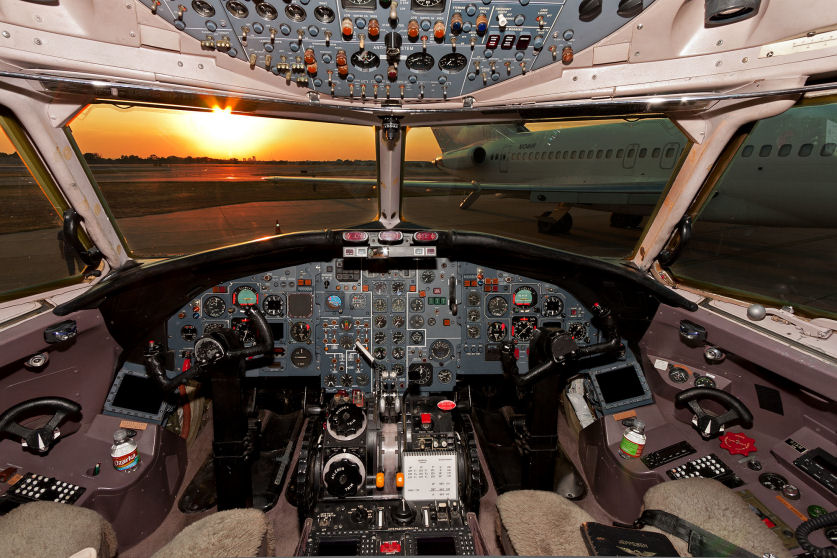
BAC 1-11 cockpit.  Notice the partial wheels on each side.

One night we were flying to Middletown Pennsylvania for an overnight.  That is the airport for the state capital, Harrisburg.  As we were descending, the weather went below our minimums.  The dispatcher and I agreed that we needed to go to Philadelphia.  Philly was not one of our regular airports, but was an alternate for Harrisburg.  You may remember my discussion about off system airports and how I hated going to them.  

We had a book in the ship's library that supposedly gave us all the information we needed at an alternate airport.  Where do we park, who fuels the airplane, stuff like that was supposed to be in there.

I had to park the plane on a taxiway, as I looked through the book for the pertinent information.  There was an FBO there, that I had visited during my general aviation days and that was listed as the company that would handle us there.  I called their frequency and they didn't know anything about us.  Long story short, I finally found a place to park.  We let the people off the plane on the ramp and they all wanted to know what was in store for them.  I didn't know until I called the company in Orlando and they were not at all prepared for this situation.

Normally, when things like this happen, the company puts everyone in a hotel, but we worked for an el cheapo airline.  They decided to hire enough buses to take the people to Harrisburg that night.  They were not happy, because it was already very late.  I was the only representative for the company on the scene.  Perry was useless.

My brother, Kevin was working in Philadelphia as a controller and I called him.  He came over to say hello and laughed at the mess I was in.  That's what brothers are for.

Next morning, the company wanted me to fly the plane to Harrisburg to position it for the normal flight back to Orlando.  We would be very late, but we could get those passengers and the plane back in the system.  However, my headaches were not over.

With tail mounted engines, the BAC is a tail heavy plane and requires ballast in the forward baggage compartment when there are no passengers onboard.  Sand bags are used normally.  We had no one who had any spare sand bags laying around, so I had to use my creativity.  I called USAir at the PHL airport and was connected with the man who was in charge of all their ramp workers.  I tried sucking up to him by telling him I had worked for USAir for 3 years and that I was in a bind.

He said he had no sand bags to spare, but he had many cartons of inflight magazines that he could bring over and they could be sent back from Harrisburg on a USAir flight later.  Brilliant.  He brought them over and had his guys load them and off we went to Harrisburg.

While I was flying with Perry for the month, I began to learn what he had said about his background before getting hired at Flex.  He had been a flight engineer at TWA, but had never upgraded there before he was furloughed.  He claimed to have flown the Mitsubishi MU-2, known as the Rice Rocket, after he was furloughed.  It is a turbo prop airplane that is very short coupled and is a very squirrely airplane.  I know, because my old pal, Weber was flying one and I had read about it.  It is challenging for good pilots, for lots of reasons and I could not imagine Perry being able to handle it and then looking so pathetic in the 1-11, a relatively docile airplane.


Mitsubishi MU-2

Dixon started digging around and there was reason to believe Perry had not been completely honest with us.  Orlando was his home town and he thought, because we were a tiny company, he could pull a fast one on us.  At the end of the month, he was called in to the office and he never showed up.  Adios II.

The third part of this story involves the pilot I mentioned earlier, who called in sick more than all the other pilots combined.  This particular pilot had busted a simulator check ride in Pittsburgh while doing a go around from a non precision approach.  I was assigned to go to USAir with the pilot and train to proficiency.  I read the notes and discussed what happened with the pilot.  It involved a simple misunderstanding, but I couldn't believe that a pilot had gotten this far and could still have this particular misunderstanding.  We discussed it, then went in the sim. and just kept doing one non precision approach after another with go arounds, until I saw one that was good enough to pass.  Badda Boom, Badda Bing.

I had been a check airman for about a year and a half and realized I did not like having these career effecting situations as much as I was having, so I returned to the line. Adios III. 


Thursday, June 2, 2016

Shit posting time.


I made this little video of myself writing my blog.


Florida Express made this little video to sell seats on our airplanes.

I had several favorite first officers to fly with at Florida Express.  One was Maurice, Pepe Le Pew.  He had a French accent and had a funny way of saying some American sayings, such as "piece of pie", instead of piece of cake.  

He was always looking for the romance with the womens and that is how he got his nickname.  He would drive his Mercedes home from the airport, wearing his pilot hat and a white scarf and if he pulled up next to an attractive woman at a light, he would lower his power window and say in his accent, "Good evening".  I guess it must have worked some times, because he continued doing it.

Maurice lived in an apartment at the Lake Fredrica Apartments.  They were on the north shore of Lake Fredrica and Maurice bought a Ski Natique boat designed for pulling water skiers.  This became the basis of several company parties on the lake shore.


When Dave was first hired, he had to do Initial Operating Experience (IOE), some of which can be done while riding on the jumpseat.  I was flying with Maurice, so Dave rode with us and Maurice suggested a landing contest.  Dave would be the judge.  Maurice was leading until the very last landing, which was mine.  I got really lucky and made one of those landings in which you don't even know when you have touched the ground.  It was a heart breaker.  Sorry Pepe.

Of course, I had opportunities to fly with Dave and that was cool, partially because it was a kind of role reversal.  He had been one of my early flight instructors and my chief pilot at Graham Aviation many years before.

Another favorite was Doug Rothermund.  Doug was a tall, thin guy, very nice and a very good pilot.  One of my favorite stories about him occurred on a pleasant evening flight from one of our cities on Florida's southeastern coast.  I can't remember exactly which one, it could have been Miami, Ft. Lauderdale or West Palm Beach.  Whichever it was, the other two flights were also returning and we were lined up on the arrival to Orlando.

We were not the first flight in line and heard the air traffic controller call traffic for the flight we were following.  "FlexAir XXX, you have traffic at XX o'clock, a Skyhawk at X thousand feet."  When he called the Flex traffic to the light plane, the pilot said, "It is not a Skyhawk, it is a Skylane."


  Cessna Skyhawk


Cessna Skylane

Can you tell me the difference between these two planes from these pictures?  Me neither, especially when they are several miles away from me, when I'm flying a jet at 250 knots.

The reason the controller makes those calls is to allow pilots in both planes to be aware of each other and to give them some basic information that will allow them to understand the performance differences and what to look for.  

The Skyhawk and Skylane are both made by Cessna and look nearly identical, especially in the circumstances I described.  Their performance is very similar for our purposes.  The Skylane is a little bigger, has a more powerful engine, carries a little more weight, goes a little faster and costs a little more.  However, the only pilot who would be compelled to correct the controller on that traffic callout would be the owner of said Skylane.  It really wouldn't make that much difference to a renter or to any of the other people involved in the situation. They are usually just referred to as Cessnas when being called as traffic.  The controller kind of apologized and corrected himself and I could tell from his tone that he was thinking, "So what?"

Doug was flying this leg and I was talking on the radio.  I kind of laughed and said to Doug that we must have been hearing the owner of the Skylane.  He kind of chuckled.  When the controller called the traffic for us, a Skylane, I asked, "Are you sure it's a Skylane and not a Skyhawk?"  (Wise ass airline pilot.)  The controller said, "Oh no, it is not a Skyhawk, it is a Skylane." as if he were talking to a child.  Doug and I would have fallen out of our seats laughing if we were not buckled in.  

From that time on, Doug and I always called each other Skylane.

Much more about Doug later.